
Wellcome Gallery: Being Human Exhibition
30/10/19
My friend Emily and I went to the 'Being Human' exhibition at the Wellcome Gallery. I found it extremely fascinating, due to the exhibition exploring various aspects of what it means to be human, and what human beings have done in the world for the world and contributing towards society. Attending the exhibition before starting the project really helped me have a rough idea of what I wanted to work towards- or what even the project further meant due to it giving example works. It helped me understand the different types of themes that I could explore, such as gender and sexuality, AI and virtual reality, diseases and technology, manmade destruction, climate change.
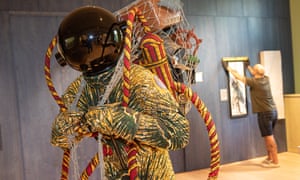
I was particularly interested in a piece at the exhibition which referenced an astronaut made of various items found in landfills and around the street, carrying a bag of rubbish. I was intrigued by this piece due to me being part of Extinction Rebellion and a massive environmentalist. So I did further reading when I went and read an article about that particular piece:
https://www.theguardian.com/science/2019/sep/01/being-human-wellcome-collection-exhibition
Is the astronaut a refugee from Earth or is the artwork grounded in the current refugee crisis? “It can be read both ways,” says Barlow. “There’s a strong antithesis going on. Astronauts are cosmic explorers and then the word ‘refugee’ ties it to a very specific context. It pulls together so many different ideas, opening up questions around colonialism and the environment.”
It is with good reason that this work serves as the exhibition’s keystone. “Refugee Astronaut is a metaphor for a post-apocalyptic figure, with his worldly possessions on his back, seeking conflict-free and environmentally clean, greener pastures,” says Shonibare. The work can be read either as “dystopian, or a note of caution” against “catastrophic climate events that will increasingly lead to migration and a scramble for scarce resources, leading to global conflict”.
The astronaut can be glimpsed from any point in the gallery, a constant reminder of the end point, the “ultimate progression”. “Maybe in this future, leaving Earth will be the only answer,” Barlow muses. “It’s a question mark on the end of the collection’s progression.”
NOT MY IMAGE BELOW: FROM ARTICLE
BEING HUMAN: Nancy Burson
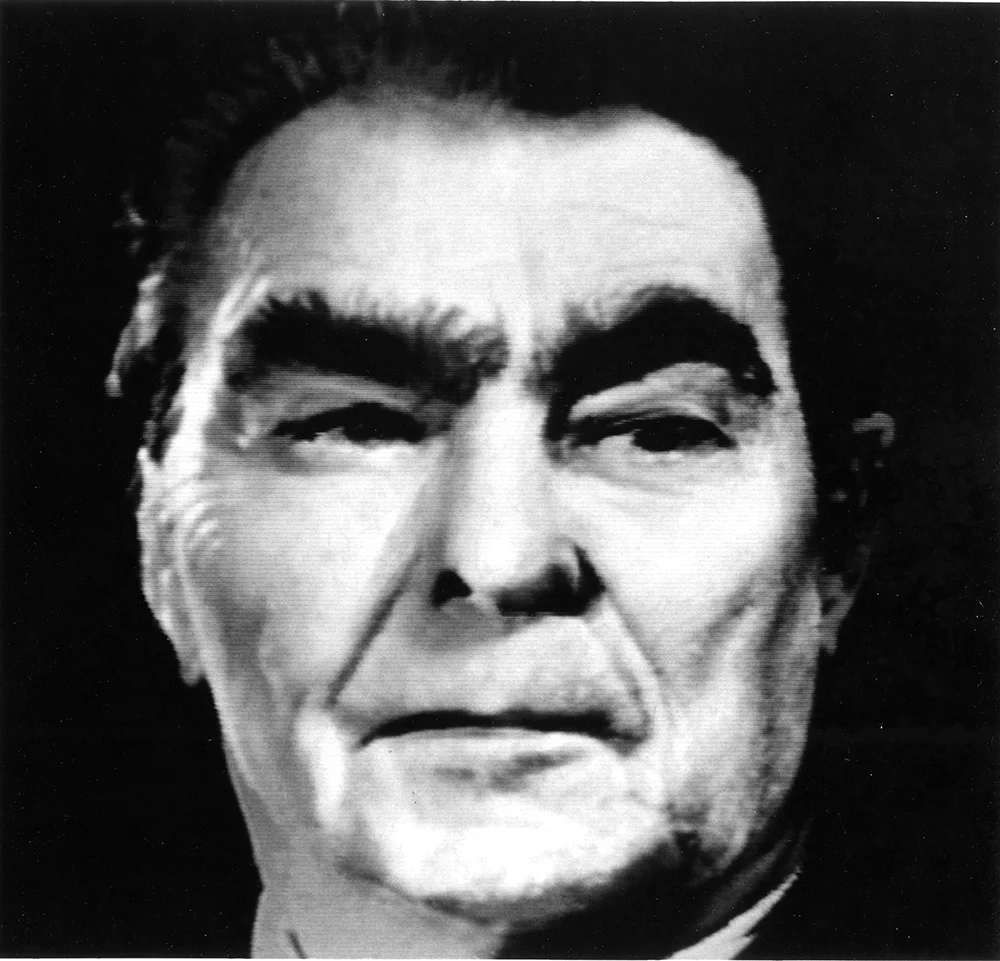
Nancy Burson was an artist that I was inspired by in terms of how she uses layering and composition to create a completely different person or object- whereby you wouldn't even know that this wasn't a real person, and rather a combination of people instead. Particularly this piece above 'Warhead I', Nancy Burson used various facial features of various political dictators and created this mash of facial features to create the ultimate dictator. Again, like referencing old tv makeup, I was fascinated by how we as individuals manipulate ourself into creating a different person in trying to fit into societal norms.
"By the early 1980s she was digitally blending the faces of groups of individuals to produce composite portraits of stock types such as businessmen, movie stars, and assassins. This composite was created using images of five world leaders, each represented proportionally by the number of nuclear warheads deployable by the nation they led: Ronald Reagan (55%), Leonid Brezhnev (45%), Margaret Thatcher (less than 1%), François Mitterand (less than 1%), and Deng Xiaoping (less than 1%)." (Met Museum)
BEING HUMAN: Kiss My Gender Gallery- Southbank
Sadly, I wasn't able to attend the Kiss My Genders Gallery as it finished on the 9th of September, however I was even just inspired by the website that had promoted it for my 'Being Human' project. Specifically LGBTQ+ activist and artist Amrou Al-Kahdi had an image on the website that really inspired me in terms of makeup and layering my images.
Unlike Old TV Makeup where it was only through black and white that you could see them, and the makeup that was produced reflected an inaccurate image of what the actors looked like, here with this coloured image that Amrou produced above, he does over-exaggerated drag makeup as that is how he wants to express and identify himself. He decides not to fit into societal social constructed norms of 'masculinity' and 'femininity' for either gender, he subverts that and instead reflects his identity as accurately as he wants to be seen by society. A complete contrast to how old tv makeup artists reflected their actors.
RE-EDIT: Christian Marclay
RE-EDIT: Christian Marclay Analysis
This specific piece by Christian Marclay - telephones, illustrates different Hollywood clips of individuals being on the phone with one another, however it creates a slow sequence of events which makes us invested with this slow moving piece. Throughout this they express a number of emotions all of the actors combined, surprise, desire, anger, disbelief, excitement, boredom and ultimately illustrate to us that everyone is having one big and slow conversation.
- element of continuity
- fascinated by the editing style - bringing so many clips that are so similar yet so different together to create something that ultimately works all together.
- mesmirsing - questioning when it will end or stop
RE-EDIT: Lenka Clayton
RE-EDIT: Lenka Clayton Analysis
Throughout this piece, there is a clear insinuation on media manipulation. It illustrates how the world can be deceiving through it being presenting within the media. Subsequently, it is illustrated how words can be deceiving in the media. The media manipulates us by using consistent words to enable us to live in fear - such as using words like 'terrorist', 'war', 'danger'. It illustrates a different type of world than what is actually occurring in the world. We are told so many different things in the media - to which some may be fake news. And in this video it is clear that it shows the power of words by using various clips in order to create a speech that would make individuals want to live in fear and create hate crimes or judgements and perceptions against certain issues. She collects various clips from different pieces in order to create a complex whole - which in effect works. Illustrating how the media can manipulate words and news as it seems so simple and realistic - as nearly Lenka was able to do it.
DATAFIED: Sophie Calle
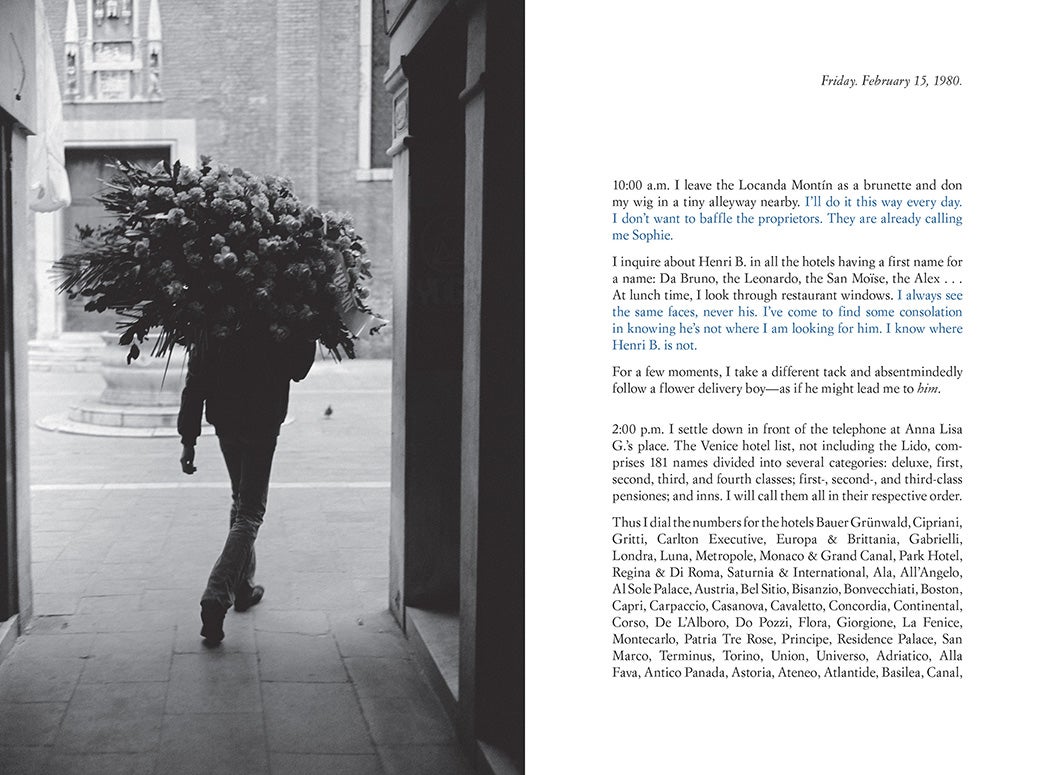
"The line between love and obsession can be blurry, as evidenced by the hit Netflix show You, which is about a stalker who uses a woman’s social media accounts to surveil and manipulate her. The simplicity of watching someone go through the motions of their day may seem romantic or creepy, depending on context, but to turn this ordinary act into art is a job for the artist. The art of following and seduction were significant practices among artists of the 1960s and 1970s, especially the conceptual artist Sophie Calle." (Dailyjstor)
I was fascinated with Sophie Calles work, as from the article it depicts that she does test the limit of surveillance and stalking, and how far someone can go to creep up on someone. I was interested at first with how one can upload a photograph or a video, whether it be something sexual, or even a picture of a dog and once its uploaded to the internet, it can go anywhere, to any website and to anyone. Within that, there is an element of stalking, and Sophie Calle depicts this perfectly, whereby she illustrates as well how easy it is for any of us to be stalked and to be considered a victim.
"The quotidian nature of her photography is what makes the art feel intimate. Art historian Giuseppe Merlino writes, “The intimacies she recounts, with texts and images, are not the results of encounters, attractions, or affinities, but of an accumulation of observed details from the programmed obsessiveness of a collector-voyeur.” For example, in another piece, The hotel (1981), Calle took up a job as a chambermaid in a Parisian hotel where she examined and photographed guests’ belongings." (Dailyjstor)
"In Calle’s work, love and voyeurism intermingle, depicted in black and white imagery with the point of interest far enough into the distance that the love transforms into voyeurism, even obsession. Love looks like a row of shoes and suits placed neatly on hangers of someone we don’t know. Perhaps more intimately, it’s a photograph of the contents of a guest’s trash bin. To know a person completely is to watch how they live, or at least pretend to be interested in how they live." (Dailyjstor)
DATAFIED: Jocelyn McGregor

I was highly intrigued by Jocelyn McGregors piece that she had on her instagram which I follow. The emerging legs which are made of 'Jesmonite' illustrate a realistic but also doll like expression of her legs.
With her work, I was inspired by also the process of how she made her work, the way she uses alginate and Jesmonite to create a depiction of something that you can't interact with physically. This idea of not being able to be in touch with the work or be with it physically due to it be emerging through the wall and not movable, illustrates some form of constraint and possibly makes the audience frustrated- sexually or in terms of pity.
On one hand it can also illustrate how us as a society use the internet and technology to find satisfaction whether that be through pornography or any other form of sexual desire through technology. We would rather immerse ourself into something that isn't real, and rather hide away behind a screen due to the fear of rejection, or the fear that we have limited control in reality. In a screen, we are able to immerse ourselves and choose what we want to watch and when, making us feel a lot more in control over the situation that we are in.
Furthermore, one could denote that an eerie vibe is emitted from these legs. They illustrate that the woman has no control over herself, she is merely depicted as a puppet some may say and that pornography depicts women as objects.
DATAFIED: Cindy Sherman

"Sherman was always interested in experimenting with different identities. As she has explained, “I wish I could treat every day as Halloween, and get dressed up and go out into the world as some eccentric character.”1 Shortly after moving to New York, she produced her Untitled Film Stills (1977–80), in which she put on guises and photographed herself in various settings with deliberately selected props to create scenes that resemble those from mid-20th-century B movies. Started when she was only 23, these images rely on female characters (and caricatures) such as the jaded seductress, the unhappy housewife, the jilted lover, and the vulnerable naif. Sherman used cinematic conventions to structure these photographs: they recall the film stills used to promote movies, from which the series takes its title. The 70 Film Stills immediately became flashpoints for conversations about feminism, postmodernism, and representation, and they remain her best-known works." (MoMA)
"Sherman has continued to transform herself, displaying the diversity of human types and stereotypes in her images. She often works in series, improvising on themes such as centerfolds (1981) and society portraits (2008). Untitled #216, from her history portraits (1981), exemplifies her use of theatrical effects to embody different roles and her lack of attempt to hide her efforts: often her wigs are slipping off, her prosthetics are peeling away, and her makeup is poorly blended. She highlights the artificiality of these fabrications, a metaphor for the artificiality of all identity construction." (MoMA)
"While she sometimes portrays glamorous characters, Sherman has always been more interested in the grotesque. In the 1980s and 1990s, series such as the disasters (1986–89) and the sex pictures (1992) confronted viewers with the strange and ugly aspects of humanity in explicit, visceral images. “I’m disgusted with how people get themselves to look beautiful; I’m much more fascinated with the other side,”2 she said in 1986. At the time, images of ailing bodies were painfully on view in the news during the AIDS crisis; these added poignancy to her investigation of the grotesque and of various types of violence that could be done to the body. In these series and throughout all of her work, Sherman subverts the visual shorthand we use to classify the world around us, drawing attention to the artificiality and ambiguity of these stereotypes and undermining their reliability for understanding a much more complicated reality." (MoMA)
DATAFIED: Off The Air Analysis
Off the air is something that I have been watching a few times on YouTube, however these three specific videos have some connotations towards the work that I am producing currently in datafied. They all look at the aspects of how technology is a thriving source, how none of us have the ability to be in a state of privacy or environment where all of our belongings on the internet and in our daily physical life are not owned by us anymore. I found the aspect of data that isn’t owned by us to be fascinating through these videos. Each video and clip within the video are not related to each other by story or art style. But the word of the video is related to each clip that is immersed in it.
The fact that each clip isnt related to each other illustrates the disconnecment within my work of the individual experience physical relations with a sex doll in themselves. Subsequently, even each style of work is so drastically different from each other in terms of art style- depicting something that is so different from each other- there are many things which illustrate disassociation and emotional attachment. One can be attached to the meaning of the work which is illustrated with the name of piece- however, there is a degree of not being emotionally attached to all the videos due to it being drastically different types of artwork all related with one another.
DATAFIED: Off The Air - Robots
DATAFIED: Off The Air - Technology
DATAFIED: Off The Air - Paradise
CONTEXTUAL REVIEW ESSAY
Contextual Review: Foundation ‘Art and Design’: Fine Art
At first coming into the ‘Foundation: Art and Design’ Fine Art course, I was feeling nervous but excited about creating new projects and ideas- however; I was still holding myself back in the beginning in wanting to experiment with other mediums. However, surprisingly towards the end I was feeling more confident with experimenting with different mediums and trying out various ways of presenting work and different materials. These changes were significantly contributed by the projects that I was given throughout the course which all explored a range of materials and ways of working.
‘Altered Space’ was the first painting project set for us; within that we had to look at how we can present altered space in any paint medium we wanted to. At first, I knew for a fact I wanted to look at confined space- thus generating ideas for this project was okay in comparison to some later projects. I didn’t however use the workshops throughout this project, and I feel that I could have definitely improved my skills further if I had done so. The main process that I used for this project was self-expression. I wanted to test my ability to work independently and see how my ideas wonder and developed. In addition, it made me question a lot more independently on the positioning of my work, the colour schemes, medium and presentation – whereby being more independent was a skill that I knew I wanted to work on for a while. I sort of felt demotivated for this project, as I think it’s because I knew exactly what I wanted to achieve – but the outcome wasn’t coming out as I wanted it to.
‘Material News’ was the sculptural project that was assigned to us as well. Like altered space, I knew that I wanted the project to be consistent about the Arab-Israeli war. I had created work in GCSE and my IB Diploma based on this politically contentious issue, and I thought it was a good opportunity to express it further as it is something that I am passionate about. That’s what I would say was good about the project, I was passionate and driven with the theme that I wanted to explore- thus I was willing to try and experiment with different mediums and ways of presenting. However; the one thing I would improve about going through this project would be try to mix different mediums together- so have some form of audio or video or even a painting within my sculpture which could have made it a stronger piece and would enable me to experiment more.
The 4D projects ‘The Self’ and ‘The Sonic Witness’ that we were assigned were both one-day projects whereby I had to create a 4D piece. ‘The Self’ was a group project whereas ‘The Sonic Witness’ was optional to be in a group or have it as an independent project. Personally, I realised that working in groups is quite stressful- having other ideas clashing sometimes benefitted in the sense of gathering different perspectives on the presentation of the work and the themes and content of the piece, however I found that working independently on ‘The Self’ project made me be able to not have too many conflicts with ideas and content – considering it was a one day project.
Doing these one-day 4D projects made me realise that I wanted to specialise in 4D. I hadn’t explored this too much previously in my IB Diploma, and surprisingly it was a pathway that I began to find a lot of passion in. My passion of 4D is further showcased in the ‘Collection’ and ‘Place’ project.
Within the ‘Place’ and ‘Collection’ project they were both projects where I had the freedom of choice to use any medium I wanted to and present it in any way I wanted. From the first and last project, I had developed my skills further within 4D and my confidence in art grew immensely. Previously in my IB Diploma and GCSE I had never touched doing a video or audio piece – and throughout this time in the Foundation course I became more confident, specifically with 4D, in wanting to try different types of mediums and ways of working and get out of my comfort zone. My strengths were mostly utilised within these two projects, due to the fact I had the freedom of choice and I wasn’t afraid to test out new mediums which I never worked with before.
Subsequently, being based in London has given me incredible opportunities to access exhibitions that influence my art or influence future projects that I want to pursue. Shana Moulton is one that I resonate with a lot – with her ideas of exploring feminine spirituality and sexuality is inspiring to me. Furthermore, having the access of Damien Hirsts ‘Mandala’ works was incredible – as it enabled me to think about the ethical decisions in art- again, something that I would love to discuss and portray in future works.
Bibliography
Oroc, J., 2018. The New Psychedelic Revolution: The Genesis of the Visionary Age.1sted. Vermont: Park Street Press.
Brus, G., 1999. Brus, Muehl, Nitsch and Schwarzkogler: Writings of the Vienna Actionists: Writings of the Vienna Activists. 2nded. Atlas Press.
Goldin, N., 2000. Nan Goldin: The Other Side. 1sted. Scalo.
Burn, G., 2001. On the Way to Work. 1sted. Faber & Faber.
Ito, J., 2010. Uzumaki. 1sted. VIZ Media.
Collings, M., 1997. Blimey. 3rd ed. 21 Publishing LTD.
Vartanian, I., 2010. Artwork: Seeing The Creative Process. 1st ed. Chronicle Books
Koos, D. W., 2018. Think Like an Artist Don't Act Like One. 2nd ed. BIS Publishers
Berger, J., 1973. Ways of Seeing. 2nd ed. Penguin Books.
Watts, A., 2017. Out of Your Mind: Tricksters, Interdependence, and the Cosmic Game of Hide and Seek. 3rd ed. Sounds True Inc.
Exhibitions:
The White Cube, London, Harmony Hammond, 11thSeptember 2019
Chalk Farm, London, Shana Moulton Exhibition, 12thSeptember 2019
Damien Hirst, The White Cube, London, 19thSeptember 2019
Ascot Berks Fine Art Exhibition, Surrey, 20thSeptember 2019
BEING HUMAN: Idris Khan
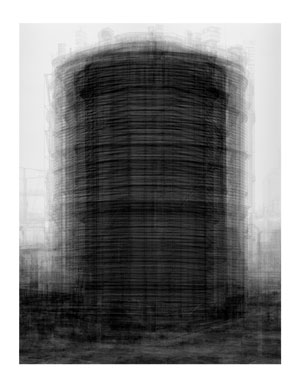
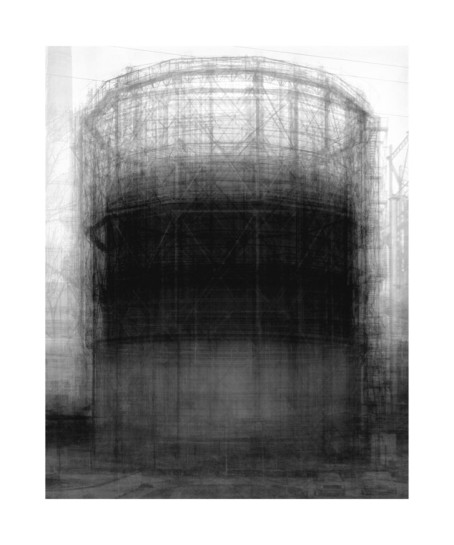
Idris Khan inspired me for this project due to his technique of layering, and creating an object/building into something that reveals a stressed/distorted point of view. He manages to manipulate his work by layering the same and different images together, creating this fake morphed building which wouldn't exist in reality. The amount of layering that he produces enables us to question what is reality. On the other hand, looking at his work it made me question the idea based on my project of how individuals have to manipulate themselves to fit into society- so with Idris Khan he manipulates his images to create this altered building which wouldn't exist in reality.
"The structures in the Bechers’ original photographs are almost identical, though in Khan’s hands the images’ contrast and opacity is adjusted to ensure each layer can be seen and has presence. Though Khan works in mechanised media and his images are of industrial subjects, their effect is of a soft ethereal energy. They exude a transfixing spiritual quality in their densely compacted details and ghostly outlines. ...Prison Type Gasholders conveys a sense of time depicted in motion, as if transporting the old building, in its obsolete black and white format, into the extreme future." (The Saatchi Gallery)
BEING HUMAN: Old TV Makeup

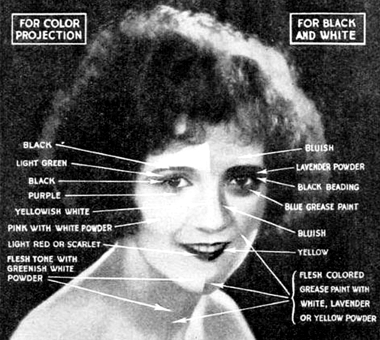
As for my project I wanted to incorporate makeup into reflecting one's gender, sexuality and identity and breaking down those norms of what defines femininity and masculinity, I was inspired by Jane Carrs 1932 inset makeup. This is how viewers at home would view her, with this extra defined makeup whereby they over exaggerated and highlighted certain features of one's face. I found it fascinating because to a degree it changes the individuals facial structure a lot, giving them a loss of their original identity- or a mask. Which is what I wanted to reflect in my work. How individuals sometimes have to create a mask in order to fit into societal norms- whether it be through makeup or without, or even changing one's hair colour or sense of style.
For old television makeup, different colours were used in order to define their features in a particular way, thus transforming their face in a completely different manner. I decided to look at an article which fascinated me, of a woman who did old tv makeup in modern day society, to see how drastically it changed her appearance.
"Well, back in the pre-talkie days, actors and actresses needed to make themselves up in highly contrasting colors for their faces to look natural on camera. This was to compensate for a light sensitivity in the cheap kind of film stock that was the industry standard of the day. To that effect, actors painted their faces in blues, purples, and yellows so they would register on screen as human, and not Voldemort-esque monsters with nostril slits and no facial contours."
"As my guide, I used this 20s vintage makeup tutorial which outlines the proper makeup to use for early black and white film. Try this at home if you feel so compelled, but don’t plan on leaving the house like this unless you’re going to a Brony convention and plan on dressing up. With that in mind, here’s what I did to look like an early black and white film star."
RE-EDIT: The Editor Essay
I found this essay to be considered quite useful when it came to understanding how one would 'Re-edit' something to connote a certain meaning within their work or even how one can alter the perception of society through their artwork. Certain key phrases really stuck with me greatly such as 'The Other'. The other references how white people usually 'otherised' other ethnicities, as they were considered a new exotic item that should be displayed and kept for collection. This made me think how in art, there is always sometimes separation between races, to otherise them and put them as the centre of attention- sometimes not for good purposes. I was further looking into Bascillos gestures and terms that he used within this essay in order to describe how one can further edit to create a certain meaning, and how that related to certain pieces of work that he referenced.
- To stretch
- to stretch something can also mean to suspend the narrative, create myths and thus changing what we saw
- To remove
- a piece that he references was _______ (boxing piece) whereby the editor of the video removed the boxers, and purely looked had the audiences reactions over certain periods of time, making us see how different the style changed over the years, how racial integration changed over the years and even with sexism, how women were able to finally see boxing matches due to the increasing number of women that were able to attend
This essay was extremely helpful for me to start off this project and gain inspiration in how one can edit, and the amount of power an editor has when it comes to presenting a video.
RE-EDIT: Cassetteboy remix the news: 2016 review special
RE-EDIT: Cassetteboy remix the news: 2016 review special ANALYSIS
I was fascinated with this video for the audio and message it created, and with the editing style as well. I found the idea of collecting various footage to create one succinct video which made sense really fascinating. This made me question the amount of power technology has. It is so powerful that it can create something that isn't real, something which doesn't exist in a primary form, but can be made into a realistic secondary form. This related with the concept of our project data collection. With the amount some people upload, it can be manipulated and altered so that individuals or groups of people can use fake data against you, causing dangerous situations.
But also, there is the concept of how the media has the power to manipulate our thoughts. The media can edit videos in order to make them more fearful or even create fake news, to the point where we are being sold the message/idea.
DATAFIED: Charles Richardson
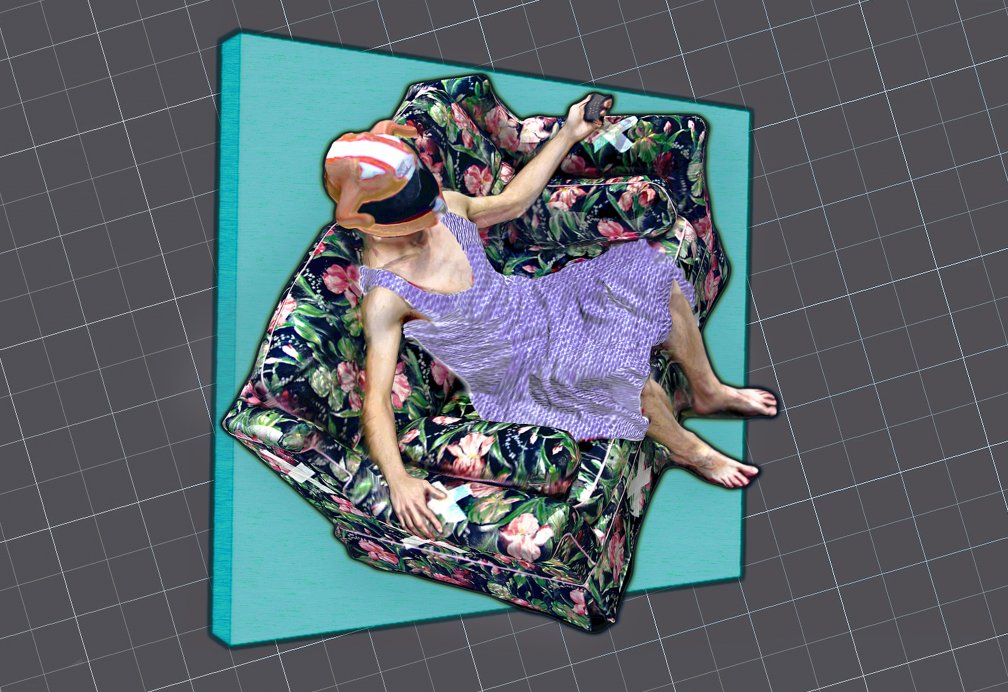
With Charles Richardsons work, I was more inspired by the presentation of his work and also the aesthetic. He combines various objects together to create one whole piece, and makes it into a 3D model. This concept of making it a 3D model almost gives the work a lifeless depiction, that it is not merely alive, has no feelings or has no identity- more prevalent with the helmet over the persons head.
DATAFIED: Charles Richardon Interview
DATAFIED: Charles Richardson transcript from interview
What are the processes behind your work?
Usually I have very abstract performances which involves strapping things in the studio onto my head, and playing around with the aspect of contemporary life and how that can be shown through a literal arrangement of things on me, then through a longer process its taken to a virtual world and produces these strange 3D heads. They have a very sculptural look to them, I'm interesting in the border between something that is sculptural and between formal life.
Is your work related to you personal life?
Tend to be things around in the studio like at the Slade, such as supermarket bags or chewing gum. Reflection of what was in my immediate environment. I don't want a conscious decision making process - I like finding things and bringing them into the creative world.
Where do you want to take your work from here?
I am very interested in installation, and Ive got the privileged next year to do it. I want to envorporate video installation and I want to try different things out. I don't want to be stuck in doing one way of doing things. When you're emerging you can try so many different things. When you are at a bigger level it is harder to branch out.
Filming - does it make you feel more confident with your work?
I think if my work was performance it wouldn't have that distance or other worldliness and wouldn't bring them out into the virtual world. Its not a fiction - it's as if the figures went through a portal. And I'm interested in the second world. I am into the grotesque and absurd and the theatre of cruelty. There is something about Hitchcocks work where he is conscious of the spectator that as an artist It has an effect on the spectator.
DATAFIED: Christiane Amanpour: Sex and love around the world

I watched this documentary on Netflix, whereby Christiane Amanpour goes to various places around the world and sees the different ways sex is portrayed and how individuals express their sexuality in different cultures. One scene that really stuck with me was when she went to Berlin, whereby these two girls would record every tinder date that they went on and subsequently record the one nights stands they would have with these people. Their overall message was that it was a way of empowerment, and how women have the power of being connected with so many people- and how tinder has given them the ability to 'pick and choose'. However, they would upload these videos with the consent of the other party, to their website.
Thus, I was interested in the aspect of privacy within this little clip that was shown in the documentary. Consciously, as a society we know that all our data is being collected, and we sometimes forget that whatever we upload to the web, will forever stay there no matter if we delete it or not. However, when we upload something we have no idea where it will end up, however we seem to ignore that aspect of data collection. Thus that made me wonder, the people the girls recorded knew that the video was being uploaded, however, once it was uploaded to the website, that footage could go anywhere. Which made me really wonder how much privacy do we even have in our general lives and even in our sexual lives.
DATAFIED: Shana Moulton - Lyrica
DATAFIED: Shana Moulton
Within Shana Moultons work 'Lyrica', there is a standard of beauty that is depicted which I found fascinating to relate to with my datafied project. Through porn, sex dolls, and virtual reality there is a standard of beauty that women have to attain sometimes, making them feel self conscious of the act of sex itself when it comes to physical intimacy - something that I was exploring as well and comes along side with the research of sex dolls for my datafied project. Furthermore, her piece of work relates to how less and less 'real' women are viewed positively - sex dolls are the future in certain cases. People revert towards technology now in this day and age. Technology is the centre of our society, it what makes and shapes us. It has influenced our sex lives to the masses. Furthermore, I found Shana Moultons visuals to be highly fascinating and intriguing. The bright colours invite ones self to see the piece in a positive light rather than what it is actually depicting - somewhat of a sadistic tone to it. Thus, I wanted to incorporate the way in which she uses visual means and different mediums in order to create different dimensions and layers within her work and incorporate it into my own.
LUX - F00173A001579_Abstractions_Quotidiennes_Laure_Prouvost_1/6 ANALYSIS
This video is highly successful in its visual skills which is what I was drawn to immediately. It was a way of getting different visuals put together, having overwhelming sensations partake in ones self - making one feel over stimulated with the work. So many senses you experience throughout the whole film may make you not collectively understand the whole concept, making it on one aspect a mind-blowing experience to which you have to isolate each individual video in order to appreciate the nuances inside. Visually, the work is highly toned down contrasting the auditory stimuli. Furthermore, I found this work to be in relation to a previous project that I worked on in part 1 - collection, as there is a collection of senses within the work itself.
LUX: Thu Tran
I was fascinated by Thu Trans acting within her piece of unboxing human hands as an 'Edward Scissorhands' recreation, the way in which she presented herself in her video was highly interesting - she had a sarcastic and ironic tone yet something that seemed genuinely impressed and happy. I was inspired by her home youtube video style as well in which to recreate it as well within my own work. Furthermore I'm interested in her sense of authenticity within her work, the home video, the bad recording style - it all seems authentic, a contrast to a technology driven society from which she is depicting that we cannot do normal things such as petting your cat when being technology driven. This makes us on one aspect just realise the downhill side that technology will take - we will not be able to function humbly as a technology driven society.
LUX: Green Therapy article
https://www.theguardian.com/society/2019/may/13/green-therapy-gardening-helping-fight-depression
This article above was something that I read in order for me to develop more content/meaning/context for the video that I wanted to make. I was fascinated with how gardening would help ones mental health - a correlation that is seemingly prevalent amongst society - within every generation. However, we are told a lot online and within the media that we should be trying out so many different things in order to help our mental health; however sometimes it all seems to get too much or ridiculous. Thus, despite the fact that there was a clear correlation between gardening helping out ones mental health - I wanted to take the mick out of it, as if it is something that we are told to do amongst many of the other ridiculous things. Subsequently, I think that there is almost a sexist undertone within the article or even suggestion as well - when thinking back to the roaring 20s, women having to be these robotic like creatures full of happiness due to the cleaning and cooking and gardening that they were doing whilst there husbands went to work. Something that I wanted to incorporate within my work.
SPACE TIME: Fred Eversley - Untitled

I found this piece of work to be fascinating. The way in which the parabolic lens is able to capture space in such a unique way is incredible. Space is distorted and altered within this lens. It makes it feel almost alienating, spacious yet confined as you feel like as if everything has to fit within that parabolic lens. Subsequently, it seems as if time is sort of distorted as well. Time for each individual looking at the object would be completely different depending on where they stand and their positioning amongst the lens.
"His work focuses on the concept of energy, fusing his training as an aerospace engineer with his creative explorations of space, color, and light. His graceful objects often evoke flight, as their subtle, translucent curves (conic sections known in mathematics as parabolas) create luminous reflections on the walls and floors of the exhibition space. Each work affects the viewer's visual experience, as shifts in light or perspective change the appearance of the object, encouraging a focus on perception and reality." (UCLA)
SPACE TIME: 'SPACE SHIFTERS' Haywards Gallery

This is a fascinating exhibition. It explores utilising space and creating something that is truly unique by altering physical images by mirroring. This Is clever and beautiful in the sense that it captivates the meaning of perception perfectly. One may look at a rock from one angle and see a completely different rock to another person 5 centimetres away from them.
"Space Shifters emulates the optical illusion of seeing through a looking glass. Almost experiencing the gallery through a lens, Space Shifters features a number of sculptures and installations that reflect and refract, mirror and shimmer, tantalising our visual senses by inviting us to become a part of each work." (Candid Magazine)
"And while, many of these sculptures and installations are brilliant stand-alone pieces, it becomes harder to understand the purpose behind exhibiting all of these pieces together as you enter the upper galleries. With the lower galleries exploring reflection and light through mirrored surfaces, the upper galleries lose focus and explore an array of themes that don’t quite tie as well together like the lower galleries do." (Candid Magazine)
"Space Shifters is, however, yet another inspiring exhibition that is guaranteed to enlighten and ignite the senses through its optical and illusory twists and turns. Make sure to give it a visit; you’ll begin to reconsider the capabilities of light and space in playful ways." (Candid Magazine)